What Carmel-by-the-Sea's Unfinished Street-Address Rollout Means for Your Closing
October 1, 2026
October 1, 2026
When Lance Anderson moved to Carmel-by-the-Sea a few years back, he ran into a problem most homebuyers never think to ask about: the bank wouldn't take his P.O. box as proof of residence, and no one on the phone could process an account for a house with no number on it. He ended up spending twenty minutes explaining to a customer service representative that his home simply didn't have a street address, before the bank declined his request outright. Getting utilities installed took similar persistence.
That story is several years old, but it explains why Carmel-by-the-Sea is in the middle of the biggest change to its physical identity in over a century, and why the change is not finished yet, even though most of the news coverage reads as if it already is.
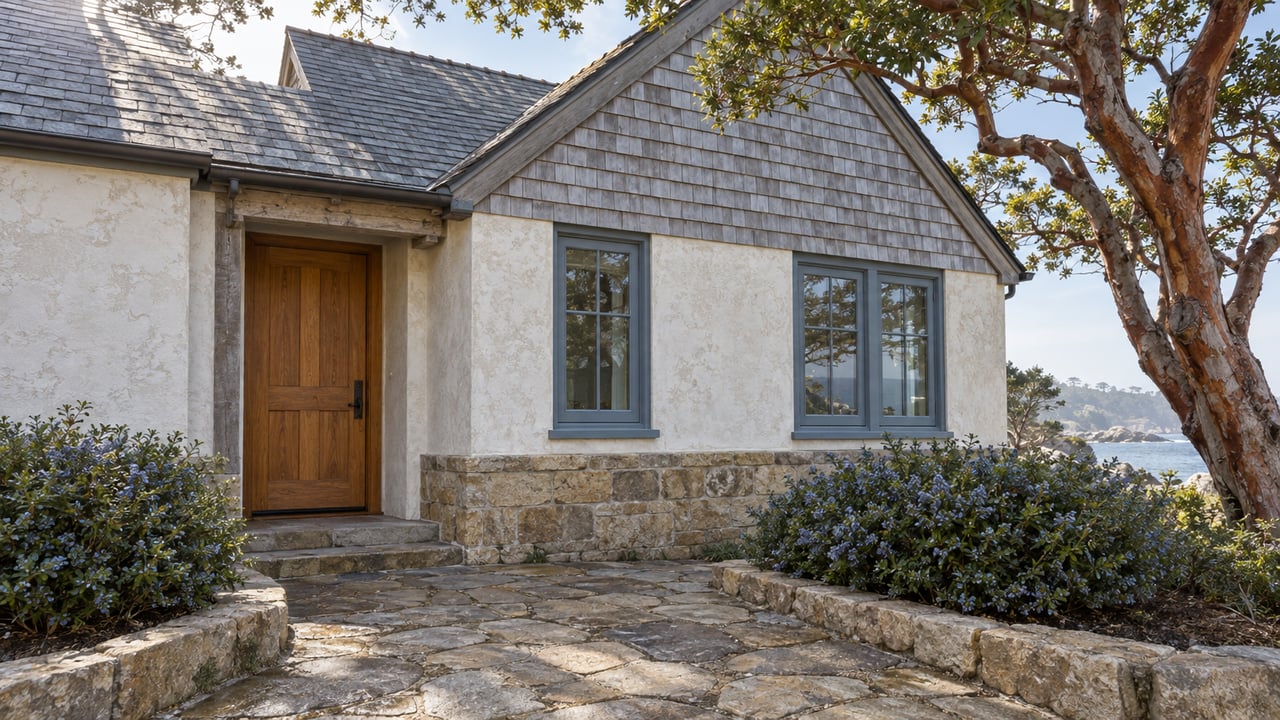
Carmel-by-the-Sea has never had house numbers. For more than a hundred years, the only building in the village with an official street address has been the post office itself, at 56B Fifth Avenue. Everyone else's home is identified by a name the owner chose (think "Merry Oaks," "Bluebird Cottage," "Oceans End") or by a directional description like "San Antonio Street, three houses south of 12th Avenue." Residents don't get mail delivered. They walk or drive to the post office and pick it up from a P.O. box, a daily ritual some in town treat as a social occasion as much as an errand.
The lack of numbers was never an oversight. It was policy, baked into a small, one-square-mile city that has also gone without parking meters, streetlights in most residential areas, and traffic signals. When California considered a state law requiring house numbers back in 1953, Carmel threatened to secede rather than comply. The bill died. Arguments over whether to add numbers have resurfaced periodically since at least 1925, according to Ferlito, who served on the Carmel City Council from 2020 to 2024 and was one of the most outspoken advocates for finally making the change.
That debate ended on December 2, 2025, when the Carmel City Council voted 5-0 to approve a standard street-numbering system for the first time in the city's 107-year history. Council member Jeff Baron, who had pushed the issue since the early days of the pandemic, called the decision a hard-won victory. Alissandra Dramov, one of the community's longest-standing opponents of numbered addresses, joined the unanimous vote, a reversal Baron later said came down to seeing years of scattered findings finally presented as one clear package.
The council's timeline called for a second reading on January 13, 2026, with full implementation targeted for the end of that May. That target has now come and gone. A report on the rollout published as recently as July 2026 still described the process in present tense: numbers being assigned along a planned grid, residents being notified, and municipal records being updated so police, fire, and other agencies work from the same system. Seven months after the vote, in other words, the project was still being implemented rather than finished.
Here is the part that matters if you are buying or selling in Carmel-by-the-Sea right now. The city's own Street Addresses project page carries a standing disclaimer on its draft numbering map: the assignments shown have not been finalized and remain subject to approval by the City Council, Monterey County, and the USPS Address Management System. Staff reports on the project continued through May, October, and December of 2025, a slower cadence than the original May 2026 target suggested, and nothing in the public record confirms the map has been finalized since.
That disclaimer is not boilerplate. It is the difference between a number you can plug into a mortgage application and a number that is still, technically, a draft. A city council vote authorizes a system. It does not, by itself, mean every parcel's number has cleared the county and the postal service and shown up in the records a lender, title company, or insurer will check.
If you are in escrow on a Carmel property this fall, the safest assumption is that some homes have confirmed numbers and others don't yet, and that the only way to know for certain is to ask the city directly rather than trust whatever number appears on a listing site or a mailbox sign.
A recorded deed in Monterey County identifies a property by its Assessor's Parcel Number and legal description, not by a street address. That has been true in Carmel for a century and it remains true today. A newly assigned street number is a mailing and navigation identifier layered on top of that existing record. It does not automatically rewrite the legal description on file with the county.
That gap is exactly the kind of detail a Monterey Peninsula title company has to manage carefully. Local title guidance already flags that Carmel-by-the-Sea homes may lack formal addresses or carry long-standing questions about property lines, which is one reason title work in the village demands extra precision. During this transition, an escrow officer may need to reconcile three things that don't automatically match: the informal name and directional description a seller has always used, the APN and legal description on the deed, and a new street number that may or may not yet be recognized by USPS and the county.
For a buyer, that means asking specific questions before assuming a number is usable. Has this parcel's assignment been confirmed, or is it still on the draft map? Does the lender's file and appraisal reference the same identifier as the title report? Has the insurance carrier's binder been issued against a number the county actually recognizes yet? None of these questions existed in Carmel real estate a year ago. They exist now, for as long as the rollout stays incomplete.
One thing the rollout does not change is how mail arrives. Reporting on the council's vote confirmed that residents will keep both a P.O. box and a street address once numbers are fully implemented, and that mail will continue to be delivered to those boxes rather than to front doors. A buyer relocating from a city with home mail delivery should not assume a new number means a mail carrier will start showing up at the house.
The practical friction that pushed the city toward numbers in the first place, difficulty with deliveries, service providers, and financial institutions, traces back to stories like Betty Kullas's, another longtime resident who described flowers and a fruit basket delivered so late they arrived spoiled, and a $13,000 prescription that never arrived at all because it needed refrigeration the post office couldn't provide. A street number solves the identification problem behind those failures. It does not, on its own, solve every logistics problem that comes with a village where the delivery model itself hasn't changed.
Does a new street number change my property's legal description? No. The legal description and Assessor's Parcel Number on file with Monterey County remain the controlling record. A street number is an added identifier for mailing, navigation, and emergency response, not a substitute for the recorded description.
Will I still need a P.O. box after the rollout is complete? Yes. Reporting on the city's plan confirms mail delivery will continue through P.O. boxes even once every property has an assigned street number.
Should I wait to buy or sell until every address is finalized? Not necessarily, but you should confirm the status of your specific parcel. Some numbers may already be recognized by the county and USPS while others remain in draft form, so the answer depends on the property rather than the village as a whole.
How do I find out if my property's number is official? The City of Carmel-by-the-Sea's Street Addresses project page is the authoritative source, and it explicitly warns against relying on any number shown until it clears City Council, county, and USPS approval.
If you're buying or selling in Carmel-by-the-Sea while this transition plays out, it helps to work with someone who tracks these details as they change month to month. J.R. Rouse Properties Group can help you confirm exactly where your property stands before you sign anything that depends on it. Schedule a free consultation to talk through what your specific address situation means for your timeline.
Stay up to date on the latest real estate trends.

Our team listens closely, works tirelessly, and puts your goals at the center of everything we do. Whether you're buying, selling, or simply exploring your options, we’re here to guide you with expertise, every step of the way.
J.R. Rouse Properties Group
574 Lighthouse Ave Pacific Grove CA 93950 J.R. Rouse | CA DRE# 01299649 | MLS ID 70010296